

Employer Services • Medical Surveillance
OSHA Medical Surveillance Programs, Managed End-to-End
When an OSHA standard requires medical surveillance, the
burden falls on the employer: schedule the right exams, act on
every result, and keep records for decades. Occu‑Med runs
that program for you — across every site you operate.

getting started
What OSHA medical surveillance requires
Medical surveillance is ongoing medical monitoring of employees exposed to specific workplace hazards, required so health effects are caught early. It is triggered by exposure crossing an action level, not by job title, and the duty to schedule exams, act on results, and retain records sits with the employer, not the clinic.
- Triggered by measured exposure crossing an action level
- Each standard sets the required exams, frequency, and provider reporting
- Most records kept for employment plus 30 years (29 CFR 1910.1020)





simple easy steps
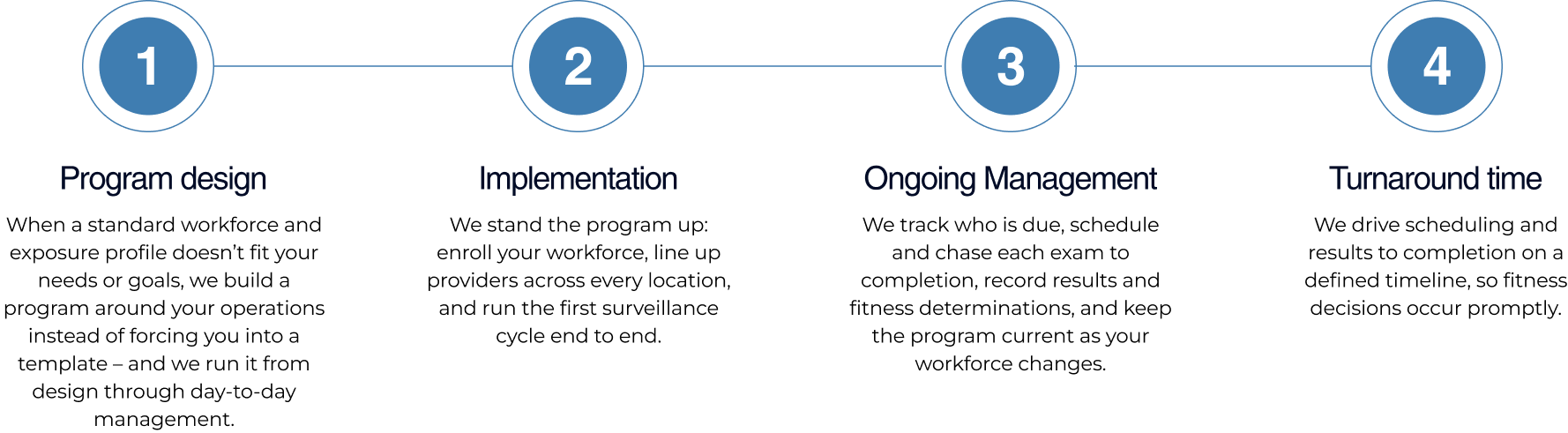
Program design, Implementation and Management
Not every workforce and exposure profile is different, so we have streamlined, standardized programs when appropriate. However, when unique requirements or needs exist, we specialize in building the bespoke program that best meets your needs and accomplishes your goals – and we run it from design through day-to-day management.
Advantages
We directly manage cost, turnaround, impact, and legal defensibility
Occu-Med does more than book appointments. We directly manage the four things that decide whether a surveillance program actually works for you:
Cost
We manage program cost head-on: the right exam with the right provider, no duplicate or unnecessary testing, and pricing we hold our network to.
Turnaround time
We drive scheduling and results to completion on a defined timeline, so fitness decisions are never waiting on paperwork.
Operational impact
We coordinate around your shifts and sites so surveillance happens with the least possible disruption to production and to your people.
Legal defensibility
Every determination and notice is documented to the governing standard and retained for the full required period, so your records stand up to an OSHA audit or a challenge.
Compliance
California employers:
Cal/OSHA goes further
If you operate in California, federal compliance is not the finish line. Cal/OSHA’s Title 8 standards can be stricter than their federal counterparts, and some have no federal equivalent, so an employer fully compliant under federal OSHA can still fall short in California. Occu-Med is headquartered in Fresno and builds California programs to the state requirement, not the federal floor.
- Cal/OSHA Title 8 can exceed federal OSHA requirements
- California-only programs apply, including Aerosol Transmissible Diseases (8 CCR 5199)
- Occu-Med is Fresno-based and coordinates California programs daily

Global
Wherever your people work,
we coordinate the exams
Your OSHA obligations follow your employees, even when the work doesn’t stay in the United States. If you are a US employer, workers posted or traveling overseas can still fall under OSHA medical-surveillance requirements, and the duty to schedule exams, act on results, and keep records stays with you.
Occu-Med facilitates these evaluations globally. We coordinate the required exams in the countries where your people are, then bring the results back into one consistent, audit-ready program. We don’t position this as a foreign OSHA-equivalent — we fulfill your US OSHA obligations wherever your workforce happens to be.
- US employers remain responsible for OSHA surveillance even for employees working abroad
- We arrange the required exams in-country, near where your people are based
- Results and records flow back into one program, in the same audit-ready format
Explore
Who needs a program
If your workforce is exposed to regulated substances or conditions, you likely have surveillance obligations. We run programs across:
Construction & remediation
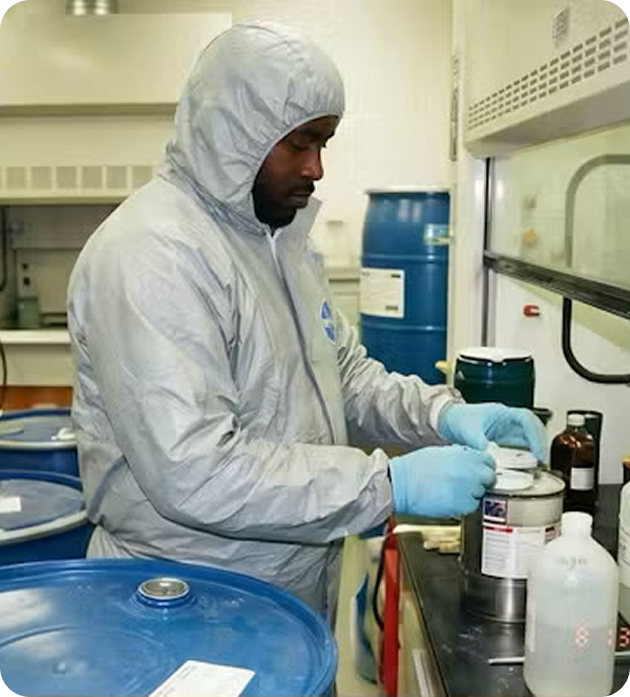
Lead, silica, asbestos, and HAZWOPER surveillance across demolition, abatement, and cleanup sites.
Manufacturing & heavy industry
Noise, metals, and chemical-exposure programs on the production floor.
Healthcare & laboratories
Bloodborne pathogens, aerosol transmissible diseases, and formaldehyde surveillance.
Public agencies & utilities
Respirator and hearing conservation programs for crews and first responders.
Oil, gas & energy
Respirator, noise, and chemical surveillance for field and plant operations.

Book a call with our team today
FAQs
FAQS Commonly Asked Questions
What is OSHA medical surveillance?
Occupational Safety and Health Administration (OSHA) medical surveillance is the mandatory medical monitoring of employees exposed to specific workplace hazards, required by individual OSHA standards to detect exposure-related health effects. Each standard defines which exams are required, how often they must be repeated, what the examining provider must report to the employer and employee (respectively), and how long records must be kept. Unlike a pre-employment medical evaluation, OSHA medical surveillance is tied to workplace exposures, and continues for as long as that exposure does. Often OSHA requires that medical surveillance be performed prior to exposure (baseline), periodically, and when exposure is anticipated to end (i.e. at the end of employment via an exit examination), although the specifics vary.
When is a medical surveillance program required and what triggers it?
A program is required when an OSHA standard covering your workplace mandates it, and the trigger is exposure type and amount. Most standards set a measurable action level, and once employee exposure meets or exceeds it for the specified duration, surveillance obligations begin. For example, the respirable crystalline silica standard requires medical exams for employees exposed at or above the action level 30 or more days per year, and audiometric testing is required once noise exposure reaches the 85 dBA action level. Some requirements are event-based instead, such as medical evaluation before an employee wears a respirator or post-exposure follow-up under the bloodborne pathogens standard.
What tests are included in a surveillance program?
Each standard sets its own required tests, so the content of a program depends on the hazards present in your workplace. Common components include medical and work history questionnaires, physical examinations, pulmonary function testing (spirometry), chest X-rays, audiograms, and laboratory work such as blood lead and zinc protoporphyrin (ZPP) levels. Most standards also require a written medical opinion from the examining provider addressing whether the employee can safely work with the exposure. Occu-Med builds the exact protocol for each covered role, so every required element is included, and nothing unnecessary is ordered.
How long must medical surveillance records be kept?
Under 29 CFR 1910.1020, most employee medical records must be retained for the duration of employment plus 30 years, with limited exceptions such as records for employees who worked less than one year and certain first-aid records. Exposure records generally must be kept for at least 30 years as well. Because these timelines outlast most HR systems and staff tenure, Occu-Med maintains surveillance records in an audit-ready format, so they’re always available when you need them.
Whose responsibility is OSHA medical surveillance compliance?
The employer’s. The clinic performs the exam, but OSHA holds the employer responsible for identifying covered employees, scheduling exams at the required frequency, supplying providers with the exposure and job information each standard requires, acting on medical opinions, and retaining records for decades. That is exactly the responsibility Occu-Med shoulders: we administer the program end-to-end so every obligation is met on schedule and fully documented.
Does Occu-Med perform the medical exams?
Exams are performed by licensed medical providers within our nationwide network of more than 15,000 locations. Occu-Med builds exam protocols based upon the job and exposures, schedules the right exams at the right intervals, equips providers with the job and exposure information, provided by the employer, each standard requires, reviews results for completeness and compliance, and maintains the records. Employees are seen close to where they work, and employers get one consistent program regardless of location.
Can Occu-Med manage surveillance across multiple states and sites?
Yes, and multi-site administration is one of the most common reasons employers choose Occu-Med. Our provider network spans all 50 states, and program management is centralized, so protocols, scheduling, and recordkeeping stay consistent whether an employee reports to headquarters or a remote site.
How is Cal/OSHA medical surveillance different from federal OSHA?
California operates its own OSHA-approved state plan, and its Title 8 standards must be at least as protective as federal OSHA, which in practice often means stricter or broader requirements. Cal/OSHA sets lower permissible exposure limits for certain substances, regulates hazards federal OSHA does not, such as aerosol transmissible diseases in healthcare settings, and carries its own recordkeeping and reporting nuances. Employers with California operations need programs mapped to Title 8, not just the federal standards, and Occu-Med builds a program that supports those needs.
Can Occu-Med design a custom medical surveillance program for our operations?
Yes. Every program we run is built around your actual operations: the hazards present, your exposure monitoring data, the roles affected, the standards and state plans that apply, and where your employees are located. We design the exam protocols and schedule, implement the program across your sites, and manage it day-to-day, adjusting as your operations, headcount, or exposure levels change.
What information does the employer receive from a surveillance exam?
Employers do not receive an employee’s medical records or diagnoses. OSHA standards and the ADA limit what may be shared. The physician’s written opinion states whether the employee can start or continue to work in or around relevant exposures, defines any limitations or restrictions on exposure or job duties, and confirms that the employee was informed of the results. Occu-Med manages this boundary carefully, so employers get exactly the information they need to act without protected health information they should not have.
What happens if a surveillance exam identifies a problem?
The applicable standard and medical circumstances dictate the response. Depending on the finding and its impact on the employee, next steps may include retesting, referral for further evaluation, temporary restriction, changes to respirator use, or a review of engineering and work practice controls. Occu-Med identifies the required actions, tracks follow-up to completion, and documents every step so your response is both protective and compliant.
Ready to start?
Make your surveillance program someone else’s full-time job
Tell us the hazards your workforce faces and where you operate. We’ll map your OSHA and Cal/OSHA obligations and run the program end-to-end, so exams happen on schedule and your records are always inspection-ready.
